
Black holes archaeology with electromagnetic and gravitational wave signals.
A Cosmic Archaeology Tool (CAT)

project logo – credits: R. Valiante
One of the biggest challenges in modern astrophysics is understanding how supermassive black holes (SMBHs), with masses between 109−1010 M⊙ formed less than a billion years after the Big Bang (z>6).
The CAT project aims to investigate:
✅ The nature of the initial black hole (BH) seeds—whether they were light, intermediate, or heavy—and how they grew into SMBHs
✅ The observational signatures of these seeds in both electromagnetic (EM) and gravitational wave (GW) signals
✅ The properties of the black hole population at cosmic dawn
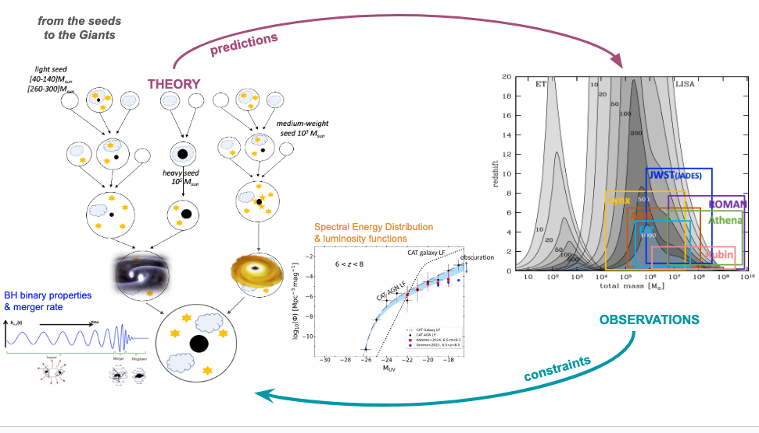
Figure: We study the evolution of the first black holes in distant galaxies, beginning with the formation of the first stars and following their development over cosmic time. Along this evolutionary path, we model both the electromagnetic emission from active galactic nuclei (AGN) and the gravitational wave signals generated by merging binary black holes. Our models are tightly connected to observations. On one hand, we use observational data to calibrate free parameters in our simulations. On the other, our predictions are used to interpret current observations, optimize observing strategies, and define science goals for future telescopes and instruments.
We study the evolution of the first black holes in distant galaxies, starting from the birth of the first stars and tracing their evolution over time. Along their evolutionary pathways, we model the electromagnetic emission from AGN and gravitational wave signals produced by merging binary black holes. Our models are closely linked to the observations. On the one hand, we use observational data to calibrate the free parameters. On the othehr hand, our predictions help interpreting observational data, optimize observing strategies and define scientific cases for future missions and instruments.
Project goals
📌 How did the first black holes form and grow?
- Investigating different seed formation channels and accretion regimes (Eddington-limited vs. super-Eddington)
- Identifying their impact on the AGN mass and luminosity functions over cosmic time.
📌What role do black hole mergers play?
- Exploring the contribution of binary BH populations, formed after galaxy mergers, to SMBH growth at z>6
- Predicting merger rates for LISA and Einstein Telescope.
- Investigating whether multi-frequency GW detections can reveal the origins of black holes
📌 How can we identify the first AGN?
- Developing new observational strategies and diagnostic tools to detect early AGN.
- Overcoming the limitations of traditional methods at high redshift.
The CAT Model: A New Approach to High-Redshift SMBH Growth
To answer these questions, we are developing CAT, an advanced theoretical model specifically designed to study the early Universe.
🔬 What makes CAT unique?
- It provides a self-consistent, environment-dependent description of the formation of the first stars and black holes.
- It resolves the smallest dark matter halos (z∼20−30), where the first stars formed.
- It complements numerical/hydrodynamical simulations, offering a fast and efficient tool to explore extreme cosmic conditions.
Bridging Theory and Observations
CAT is more than a model—it’s a key tool for interpreting observations from the world’s most advanced telescopes.
We work in collaboration with scientists involved in current and future missions, including:
🛰️ The James Webb Space Telescopes
🔹 Deep infrared surveys
🛰️Athena, Lynx, AXIS
🔹X-ray studies
🌍 Ground-Based Observatories
🔹 MOONS (VLT) – Spectroscopic galaxy surveys
🔹 Einstein Telescope (ET) – Gravitational wave detection
🔭 Future Missions
🔹 LISA – Detecting GW signals from BH mergers
🔹 Euclid – Exploring dark matter and galaxy evolution
Collaborations and Scientific Impact
Our work is closely linked to major research initiatives at INAF-OAR such as HSC, JWST_Extragal, RELIGHT, and highzgal, involving leading scientists at the Astronomical Observatory of Rome (OAR).
🔗 Our ultimate goal? To build a comprehensive cosmological framework explaining the evolution of AGN, from dormant SMBHs to the bright quasars observed at z>6
📢 Want to learn more? Stay tuned for updates on our latest discoveries in the early Universe! 🚀
contact: rosa.valiante@inaf.it
The team at OAR
Rosa Valiante
Nazanin Davari
Luca Zappacosta
Angela Bongiorno
Antonello Calabrò
Marco Castellano
Adriano Fontana
Marco Limongi
Nicola Menci
Emiliano Merlin
Laura Pentericci
Enrico Piconcelli
Paola Santini
Scientists at other INAF observatories
Roberto De Carli INAF-OAS (Bologna)
Alessandra De Rosa INAF-IAPS (Rome)
Paola Severgnini INAF- OAB (Brera)
Jasbir Singn INAF-OAB (Brera)
External Collaborators (from other institutions)
Luca Graziani University of Sapienza (Rome)
Raffaella Schneider University of Sapienza (Rome)
Tommaso Zana University of Sapienza (Rome)
Alessandro Lupi University of Insubria (Como)
Alessandro Trinca University of Insubria (Como; postdoc)
Roberto Maiolino University of Cambridge (UK)
Ignas Joudzbalis University of Cambridge (UK)
Marta Volonteri IAP (France)
…