
Only 5% of the Universe is “visible” matter!
Ordinary baryonic matter, made of protons, electrons, and known subatomic particles that forms all physical objects in the Universe, from stars to the cores of black holes, constitutes only 5% of the energy budget of the universe, which mainly includes dark matter and dark energy.
The research team at the Astronomical Observatory of Rome investigates these fundamental aspects of modern cosmology, aiming to understand the nature, origin, and role of these invisible components in the formation of cosmic structures and the evolution of the Universe.
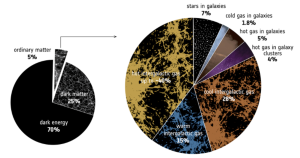 As reported in the pie-chart, in turn, this 5% is divided into a component of easily quantified and observed matter (45% visible in galaxies in groups and clusters of galaxies) and a diffuse and hot component (1e5-1e7 K) that should be associated with the intergalactic and circumgalactic medium, but which is difficult to identify and locate, as can be seen in the graph on the right where the observations of the mass of baryonic matter (Y-axis) detected in proximity to structures of different dynamic mass are summarized, from the simplest and lightest (single galaxies) to the most complex and massive (galaxy clusters). Only in the most massive structures (> a few x 1e14 solar masses) is the detected baryonic mass consistent with that expected based on the universal baryonic fraction (Ωb/ΩM) in the observed Universe.
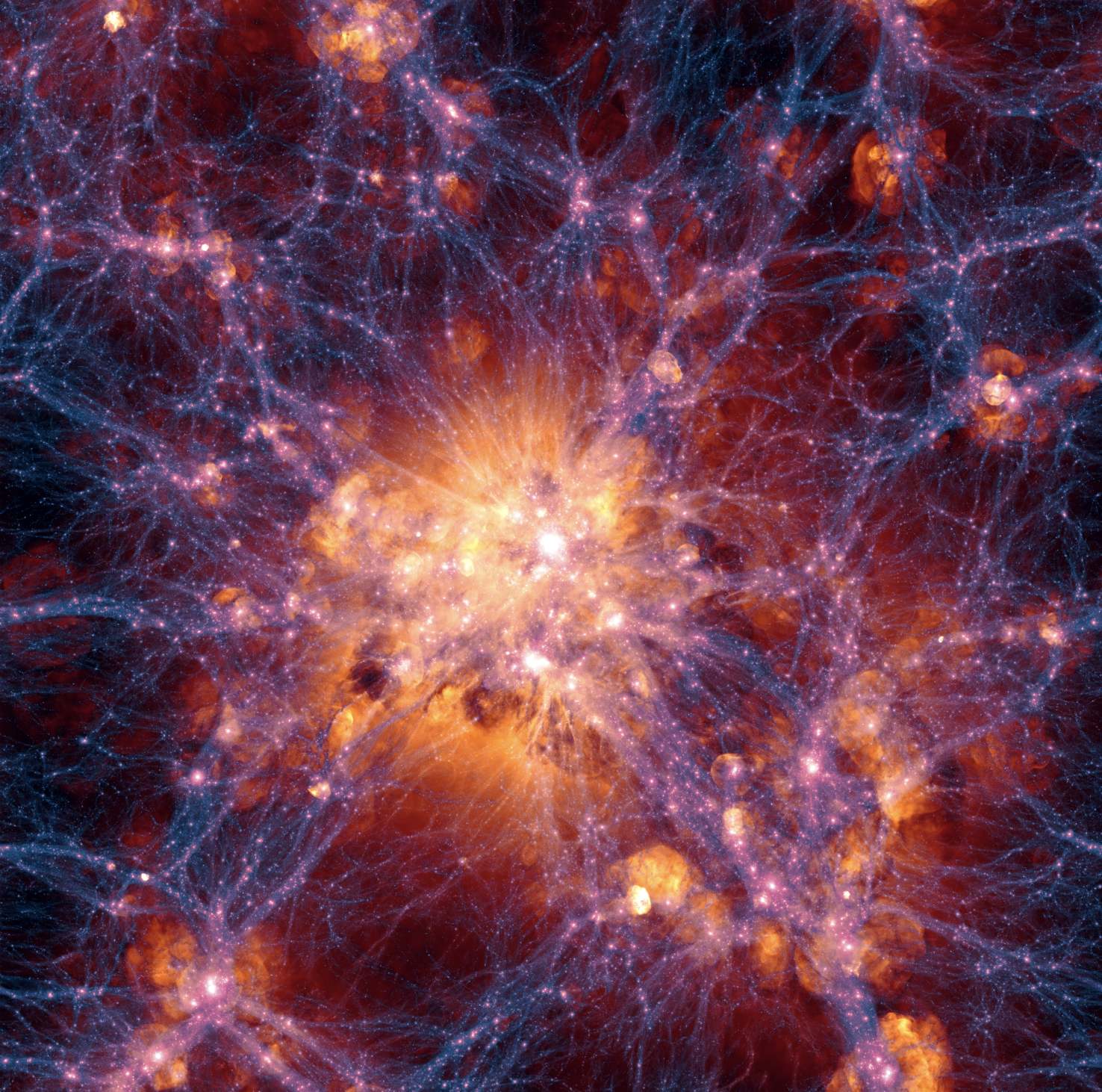
Visualization of the large-scale structure of the Universe from the Illustris Project cosmological simulation. Dark matter is shown in blue and gas distribution in orange. Centered on a massive galaxy cluster in the present-day Universe, the image spans a region about 300 million light-years across. Credits: Illustris Collaboration
Ongoing activities
- Hunting for the missing baryons through data-analysis & modeling, particularly in the Milky-Way and in the CGM of external galaxies
- Simulations for future missions (i.e. Athena, HUBS, etc.)
and more…
The research team
Fabrizio Nicastro
Luca Zappacosta