
The Astronomical Observatory of Rome is home to a diverse team of researchers specializing in various areas of extragalactic astrophysics and cosmology. Their work spans the study of galaxies, active galactic nuclei (AGN), and the intergalactic medium, as well as the fundamental components of the Universe, including dark matter and dark energy. Utilizing cutting-edge observational facilities, such as the James Webb Space Telescope, they analyze vast amounts of data to unravel the mysteries of the cosmos. To interpret their findings and investigate the underlying physical processes, researchers also develop and apply sophisticated theoretical models.
The Extragalactic Astrophysics and Cosmology research teams focus on integrating data analysis from experiments, numerical simulations, and fundamental theory to deepen our understanding of the Universe. Our research aims to answer key questions such as:
- What is the origin of our Universe?
- How did the Universe undergo reionization?
- What is the nature of dark matter and dark energy?
- What are the properties of the intergalactic medium at different epochs?
- How did galaxies form and evolve across cosmic epochs?
- What is the origin and growth history of the first super-massive black holes?
- What is the nature of the active galactic nuclei and of their cosmic evolution?
- What can gravitational waves reveal about (massive) black hole mergers and the nature of gravity?
- Where are the “missing baryons”?
- What are the properties of the hot and tenuous filamentary gas between galaxies, known as the warm-hot intergalactic medium (WHIM)?
- …
Over the past few decades, groundbreaking observations have significantly advanced our understanding of the cosmos, leading to the development of a standard model of the Universe. The detection of gravitational waves from black hole-black hole (BH-BH) mergers has opened a new window into astrophysics, providing direct insight into the nature of compact objects and the behavior of gravity in extreme conditions. However, many fundamental questions remain unanswered, or have yet to be formulated. Future progress will depend on a combination of new observational data, advanced simulations, and theoretical insights.
The various research teams at OAR are actively involved in international projects and collaborations, working closely with institutions and scientists worldwide to advance the field. In addition to their research activities, they play a key role in training and mentoring students and young researchers, fostering the next generation of astrophysicists through hands-on experience, specialized courses, and collaborative research opportunities.
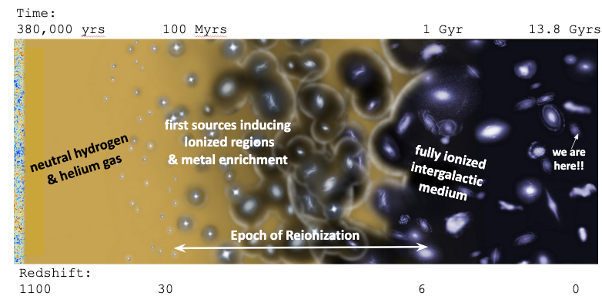
Evolution of the Universe and the Epoch of Reionization. This figure schematically represents the evolution of our Universe. For many years we have been exploring with our telescopes the so-called epoch of reionization during which the intergalactic medium (i.e. the medium that lies between galaxies) passed from a totally neutral state to an ionized one. This period goes from about 100 million years up to 1 billion years after the big bang and is fundamental because the first stars contained in the first galaxies and the first black holes were formed right during this epoch.
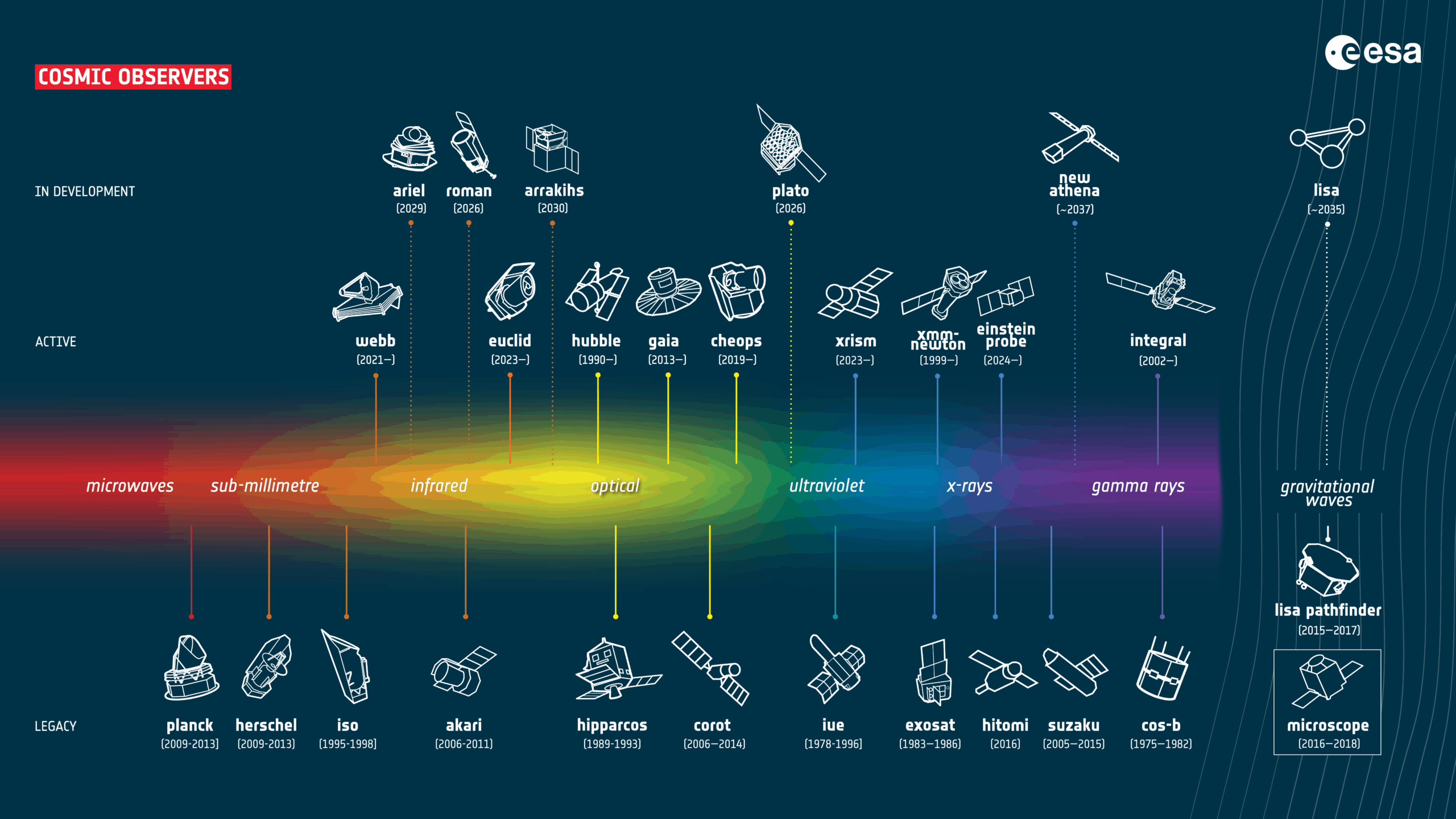
Observing the Universe: Telescopes and Missions Overview. Here are the telescopes, detectors, and missions at our disposal.
The fleet of astronomy missions observing the Universe across the electromagnetic spectrum, from microwaves to gamma rays. These missions enable astronomers to tackle big questions such as the origin and evolution of our Universe, from its early beginnings to the stars and galaxies we observe today, and to investigate the fundamental laws that govern the cosmos – updated 28 May 2024.
Credit EAS LICENCE CC BY-SA 3.0 IGO
Our Research Activities
The ongoing research at the Rome Astronomical Observatory spans a wide range of topics in extragalactic astrophysics and cosmology. These efforts are often organized into key thematic areas, including:
🌌 Formation and Evolution of the First Galaxies
- Investigating the stellar, metal, and dust content of the earliest galaxies
- Studying the physical properties of high-redshift star-forming galaxies through spectrophotometric analysis
- Exploring the epoch of reionization through deep spectroscopic observations of Lyα emission
- Analyzing the luminosity function of AGNs at z > 4 and their contribution to cosmic reionization
- Examining the effects of cold and warm dark matter on galaxy properties and their redshift evolution, in comparison with observational data
🕳️ Supermassive Black Holes and Cosmic Evolution
- Understanding the origin and early growth of the first supermassive black holes and their co-evolution with host galaxies
- Developing semi-analytical models for black hole and galaxy formation
- Conducting a census of local supermassive black holes and studying obscured accretion processes through direct hard X-ray detection of AGNs in medium-deep extragalactic survey fields
🧭 Cosmology and the Large-Scale Structure of the Universe
- Investigating the properties and evolution of dark matter and dark energy through weak gravitational lensing
- Developing and testing theoretical models of dark energy and modified gravity
- Studying the warm-hot intergalactic medium (WHIM) and searching for the “missing” third of the ordinary (baryonic) matter in the Universe
This list represents just a portion of our active research lines, which are continuously evolving thanks to new observations, advanced theoretical modeling, and international collaborations.
Content continuously updated…
Research areas
Galaxy formation and evolution
Cosmology and the Large scale structure of the Universe
PROJECTS
- FLAGS
- Euclid@OAR
- RELIGHT
- RECAP
- JWST_extragal
- highzgal
- AstroBlack-Italy
- Agile@LSST (pagina già presente su vecchio sito OAR – gestita da Angela Bongiorno: https://www.oa-roma.inaf.it/lsst-agn/)
Team webpages
- CAESAR Cosmology And Early Structure Assembly in Rome
About us: press-release and media
- A dormant BH captured by Webb
- the sleeping beauty
- Massive black hole in the early universe is lying dormant in its host galaxy
- “Apri gli occhi al cielo”
- “Le ragazze delle stelle”
- Early Black Holes May Have Grown in Fits and Spurts
- Laura Pentericci – RECAP
- An ultra-faint galaxy at the Epoch of reionization
- PROBING THE EARLIEST GALAXIES AND THE EPOCH OF REIONIZATION
- spiderweb
- The titans of the Universe – video
- Hyperluminous quasars at the Epoch of Reionization
- NASA’s Webb Draws Back Curtain on Universe’s Early Galaxies
- Interviews on ”INAF multimedia”: http://gallery.media.inaf.it/main.php
page under construction