
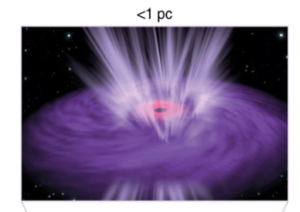
artist’s concept illustrates a supermassive black hole with X-ray emission emanating from its inner region (pink) and ultrafast winds (light purple lines) streaming from the surrounding disk. Credit: ESA
At the center of almost all galaxies resides a supermassive black hole, with a mass between a million and a few tens of billions of solar masses.
In a substantial fraction of galaxies, the matter accreting onto the black hole heats up and emits radiation according to Einstein’s famous formula E=mc². This process is so efficient that it can reach enormous luminosities, up to 100-1000 times that of the galaxy hosting the black hole. This phenomenon is called an active galactic nucleus (AGN) and, in the case of the most luminous manifestations, quasars.
Quasars, Black Holes, and Galaxies: A Legacy of Research
At the observatory, we have a long tradition in studying the properties of quasars, both local and distant, at the epoch of reionization, through observations at all wavelengths, from mm to X-ray, using the largest telescopes on the ground and in space. We do this both by studying peculiar objects or small, carefully selected samples in detail and by conducting statistical studies through large area surveys.
In addition, we study the properties of galaxies that host massive black holes to understand if and how their characteristics are influenced by the presence of the black hole. We do this through statistical studies using survey data and are involved in the most important projects such as COSMOS, JWST, Euclid, and also future projects such as LSST.
One of the most important discoveries of the last 20-30 years in the field of extragalactic astronomy is the existence of a scaling relation between the mass of a galaxy and the mass of the supermassive black hole at its center. The ratio is ~1000, so the largest galaxies host the most massive SMBHs. This relationship is extraordinary given that it links processes that occur on remarkably different scales (a factor of 106, as if phenomena occurring in this room were to affect the entire Earth).
Potentially, the black hole can substantially affect the properties and evolution of the surrounding galaxy. One of the most effective mechanisms for a massive black hole to interact with its host galaxy is by launching powerful outflows (winds), namely matter that is accelerated by the enormous radiation pressure produced by the massive black hole.
Furthermore, our team develops theoretical models for the formation of supermassive black holes and galaxies, including the first quasars at the Epoch of Reionization, in order to understand the main physical processes regulating their assembly and (co-)evolution across cosmic epochs. Our models are anchored to observational data, serving as tools to interpret them, to define the science goals and technical requirements of future missions/instruments as well as to make predictions for the sources of electromagnetic and gravitational waves in the yet unexplored Universe.
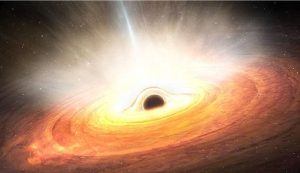
Artist’s conceptual illustration of a supermassive black hole surrounded by a glowing accretion disk and launching high-energy particle jets or winds into space. Credits: ESA
How does a black hole grow?
The matter settles into an accretion disk, spiraling until it is captured by the SMBH. Heating up due to friction at very high temperatures, it emits radiation in the optical/ultraviolet/X-ray bands.
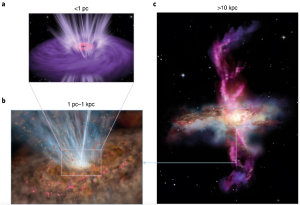
Artist’s impression of a multiphase AGN-driven wind, illustrating its different phases and spatial scales: from the central engine (<1pc; a), through the interstellar medium (1pc-10pc; b), out to the boundaries of the host galaxy (>10pc; c). Credit: Cicone et al. 2018 Nat. Astron. 2, 176.
One of our main research activities is the discovery and characterization of black hole-driven winds, which are multi-scale (from the nucleus to the host) and multi-phase (neutral, ionized, molecular) phenomena. This is a rapidly expanding field on which observations from the world’s major telescopes are focused. We are very active in this field from both an observational and theoretical point of view, with leadership roles in international collaborations.
Ongoing Activities
- The origin and early growth of the first supermassive black holes and their co-evolution with their host galaxies
- the nature of BH seeds (light, medium-weight or heavy) upon which the SMBHs have grown
- the observational imprints of seeds in the electromagnetic and gravitational wave windows
- AGN and Quasar population properties at cosmic dawn.
- The Luminosity Function of z>4 AGNs and their contribution to the Reionization
- Census of the non-local supermassive black holes and the obscured accretion contributing to the Cosmic X-ray Background via direct hard X-ray detection of AGNs in medium-deep extragalactic survey fields
- Co-evolution of galaxies and AGNs with semi-analytical models
The research team
Angela Bongiorno
Antonello Calabrò
Nazanin Davari
Nicola Menci
Fabrizio Nicastro
Enrico Piconcelli
Rosa Valiante
Luca Zappacosta