
Looking at the sky to discover the Dark Universe
Many scientists at OAR are working on the ESA’s Euclid mission, a satellite launched in 2023 to observe about 14,000 square degrees of the sky over six years; it will measure the position and shape of billions of galaxies; it will also determine the accurate distance of millions of galaxies to build a 3D map of the visible universe. By then using gravitational lensing and the distribution of galaxies in space, it will be possible to “convert” this visible 3D map into a 3D map of the dark universe.
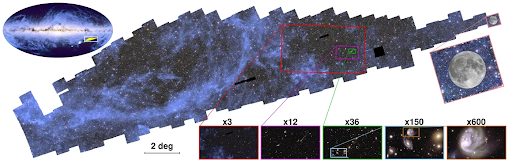
This image shows the Euclid resolving power, zooming from an area of about 100 sq deg down to a single object; even magnifying 600 times, there is no blurring, which shows the sharpness of Euclid’s images. image credits TBI
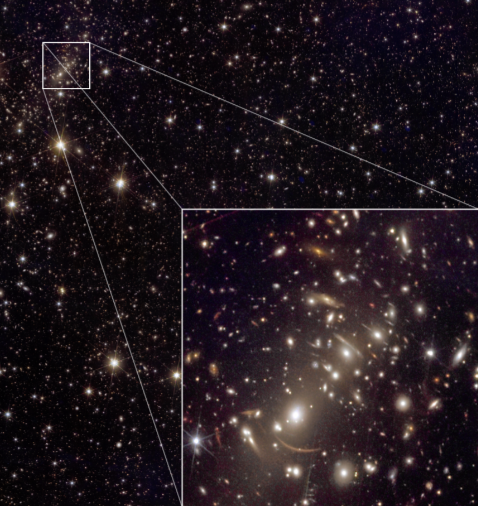
A cluster of galaxies with strong lensing effects observed in the first observations that will be made available to everyone
Thanks to its wide field of view, instrument sensitivity and resolution, the data collected by Euclid are optimal for various fields of research, beyond the core science (cosmology), such as the study of the Local Universe, and of low surface brightness objects including the diffuse light present in galaxy clusters which will allow constraining the profile of dark halos by providing information on the nature of dark matter, but