
Understanding the formation and evolution of galaxies is one of the key questions in modern Extragalactic Astrophysics. The Extragalactic Team is working on different science topics.
The fantastic data from the new James Webb Space Telescope (JWST) allows us to obtain both images in various infrared bands and, for the first time, also spectra with high resolution from space. Researchers in our group are involved in processing this data and building galaxy catalogs.
For example, we recently published a catalog of about half a million sources on the fields that you see represented here. In one of the observed fields, we discovered some of the most distant known galaxies, of which we were also able to confirm the exact distance through spectroscopy.
We work with data from large international collaborations of which we are active members, with public data, and finally with proprietary data.
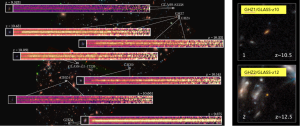
Left: James Webb Space Telescope (JWST) NIRSpec 1D and 2D spectroscopic observations and redshift measurements of high-redshift galaxies and candidate active galactic nuclei (AGNs) in the GLASS-JWST field behind the galaxy cluster Abell 2744. Right: The image shows early galaxies GHZ1/GLASS-z10 (redshift z ≈ 10.5) and GHZ2/GLASS-z12 (redshift z ≈ 12.5) captured by the James Webb Space Telescope (JWST) behind the galaxy cluster Abell 2744.
Two examples of the many studies we are conducting with the James Webb data are reported below.
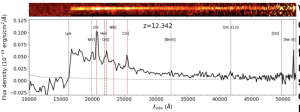 We are using this data to find answers to many open questions. For example, what are the physical properties of the very first galaxies, i.e., their stellar mass, gas, metallicity, star formation rate, and so on? In this figure, you can see the spectrum taken with JWST of one of the most distant known galaxies, which shows emission lines from many elements like carbon and oxygen.
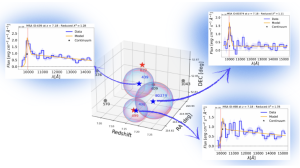
When did the first “bubbles” form? By searching for particular galaxies that emit in the UV Lyman-alpha line, we can then look for and study the very first regions that were ionized. In this figure we see one of these so-called “bubbles” that we discovered at an epoch corresponding to about 500 million years after the Big Bang, and it was created by the ionizing photons of 6 galaxies very close to each other.
Ongoing Activities
- The stellar, metal, and dust content of the first galaxies
- Semi-analytical models of galaxy formation
- Exploring the epoch of reionization through deep spectroscopic observations
- The physical properties of high redshift star forming galaxies from spectrophotometric analysis
- The search for LyC emission in galaxies at redshift 3-4
- The history of galaxy mass assembly and the analysis of galaxy stellar populations
- The emergence of passive galaxies
The research team
Antonello Calabrò
Marco Castellano
Adriano Fontana
Nicola Menci
Emiliano Merlin
Lorenzo Napolitano
Laura Pentericci
Paola Santini
Rosa Valiante