
The “Star and Planet Formation” group activity focuses on observational studies of young stellar objects, their evolution and the evolution of their planetary systems. The main group activities are:
- Study of the phenomena connected with the activity of pre-main sequence stars and dispersion of their circumstellar disk: accretion and winds, protostellar jets and outflows.
- Characterisation of low mass young stellar objects: magnetic activity, elemental abundances, physical properties as a function of the environment
- Variability of young stellar objects: monitoring and spectroscopic/photometric characterisation of eruptive variables
- Study of proto-planets formation and disk-planet interaction through very high resolution imaging
- Discovery and characterisation of planetary systems, analysis of the properties of their hosting star and star-planet connection
For the investigations mentioned above, the group utilises forefront instrumentation both from the ground (VLT, LBT, TNG) and from the space (JWST, HST) with studies at high spatial and spectral resolution, through numerous national and international collaborations. The group is also involved in consortia and scientific groups for the development of instrumentation at high angular resolution (e.g. MAVIS@VLT, MIKADO@ELT, PCS@ELT) and high dispersion (e.g. ANDES@E-ELT, MOONS@VLT, HRMOS@VLT, SoXS@NTT)
 |
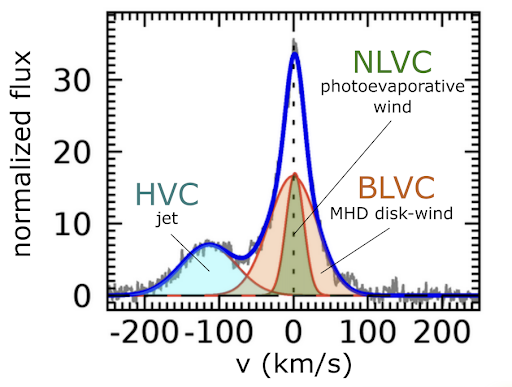 |
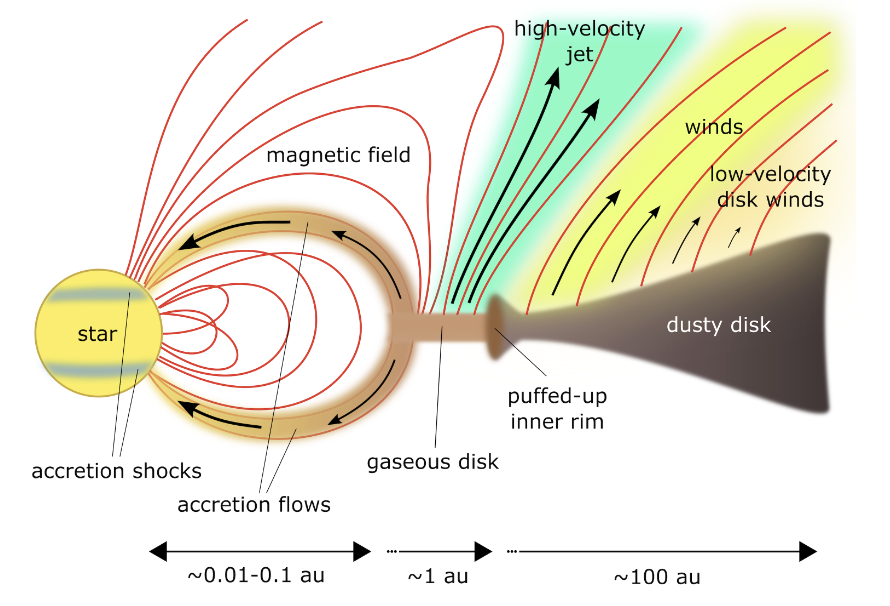
Fig. 1: Left: sketch of the disk-star interaction region in a low-mass young stellar object, following the magnetospheric accretion model (Credit: S. Antoniucci). The OAR “Star and planet formation” group studies the different active regions around this type of objects related to mass accretion and ejection, and how they influence the young star properties. Right: example of a high resolution spectrum of the [OI] 6300 A spectral line observed in a young star with the GIARPS instrument at the Telescopio Nazionale Galileo (adapted from Nisini et al. 2024). The high resolution allows one to spectrally separate emission components originating in different regions. For these types of studies our group is involved in the development of future instrumentation as ANDES@ELT and HRMOS@VLT.
 |
 |
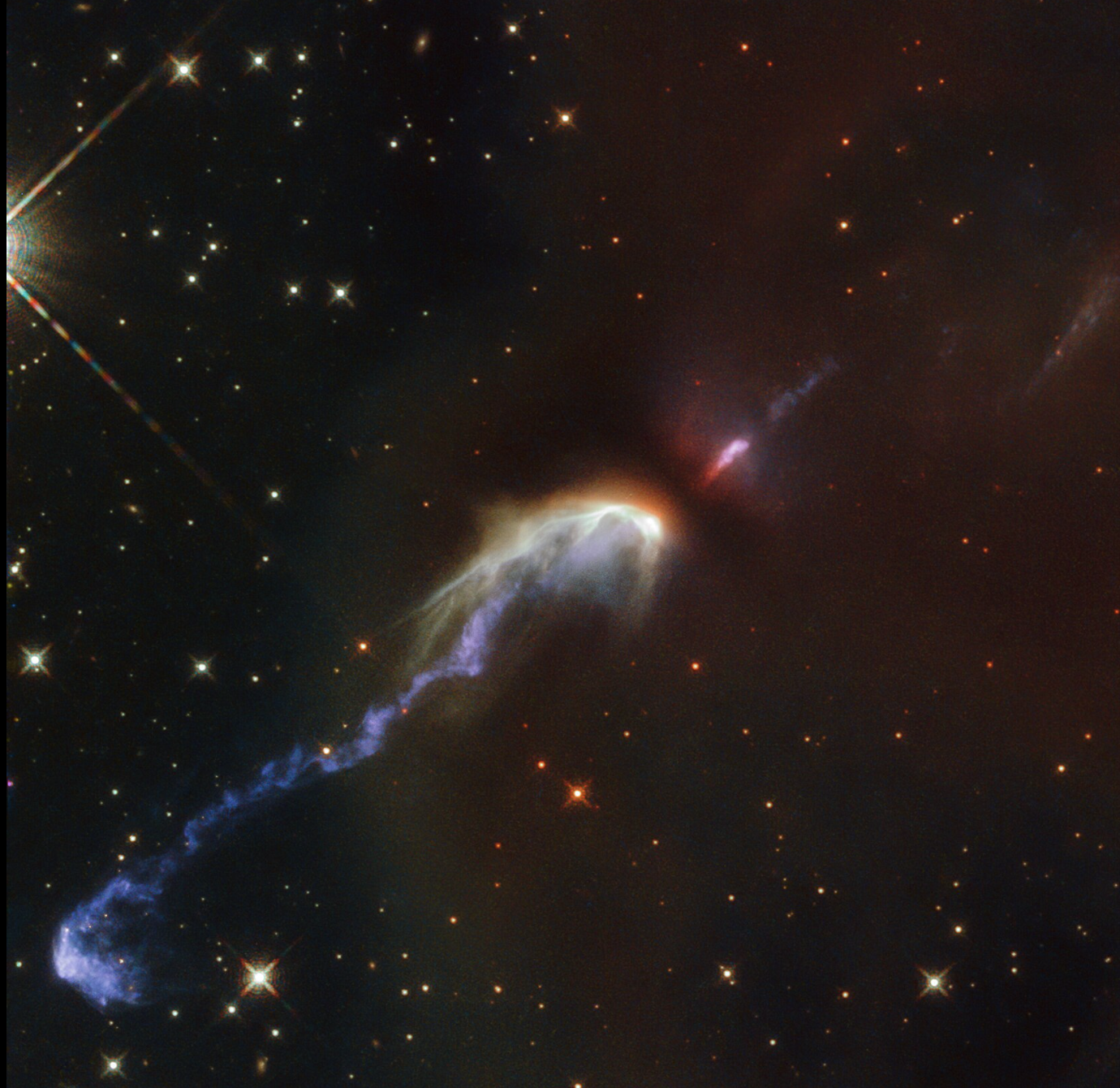
Fig.2: One of the most spectacular phenomena connected with star formation are the powerful jets of matter originating during the stellar accretion phase. Our group studies the origin of these jets and their physical properties through observations at different wavelengths, from UV to far IR. Left: HST image of the jet from the HH46IRS protostar, located in the Puppis star forming region (Credit: ESA/Hubble & NASA, B. Nisini). Right: JWST spectral images of the central region of HH46 IRS in the near- and mid-IR (Nisini et al. 2024).

Fig. 3: Multi-band image of the young low-metallicity cluster NGC346 in the Small Magellanic Cloud obtained with the instrument NIRSpec of the JWST (Credits: NASA, ESA, CSA, Jones, De Marchi, Meixner, Pagan, Habel, Lenkic, Chu). Our group studies the star formation processes in distant clusters of our Galaxy and in nearby Galaxies to understand how the different environments (e.g. presence of strong UV fields, metallicity, stellar density) affect the properties of the forming stars and their proto-planetary disks (e.g. De Marchi, Giardino, Biazzo et al. 2024). These studies are performed with the JWST and instruments at LBT (Biazzo et al. 2025, in prep), and in the future with MOONS@VLT.

Fig. 4: Extremely high-resolution optical image of the proto-planetary disk of the young star CQ Tau, obtained with the instrument SHARK-VIS at the Large Binocular Telescope (LBT) (Antoniucci et al. 2025, in prep). This instrument, developed and built at OAR, allows one to observe at spatial scales of the order of tens of au around young stellar objects, and it is used by our group to search planets in formation within the young star’s disk and study the disk optical properties.
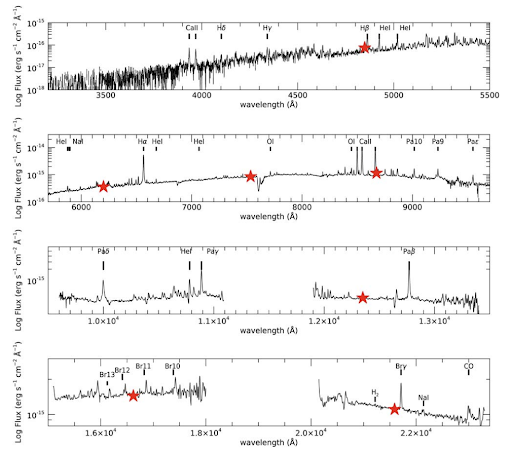
Fig. 5: Optical-IR spectrum of an EX Ori type variable obtained with the MODS and LUCI instruments at LBT (Giannini et al. 2024). Our group studies the young stellar objects variability due to accretion instabilities. We analyse, in particular, spectroscopic follow-up of burst events signalled by photometric surveys such as Gaia in the past and LSST in near future.
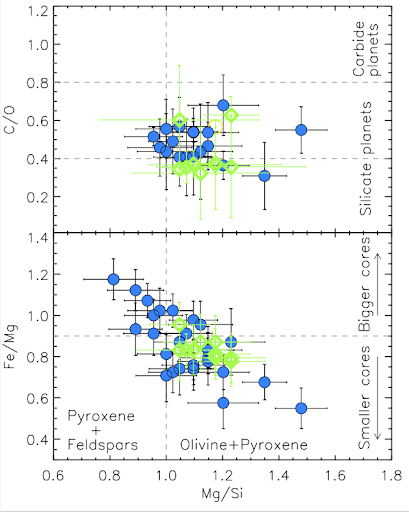
Fig.6: C/O and Fe/Mg abundance ratios as a function of the Mg/Si ratio, obtained by our group in the framework of the GAPS project for a sample of stars with transiting planets and in a wide interval of astrophysical parameters (blue: Biazzo et al. 2022; verde: Filomeno et al. 2024). The horizontal lines separate the regions where planets are dominated by carbides or silicates (upper panel) or they have bigger iron cores (lower panel). The vertical line separates regions where magnesium in the mantles forms pyroxene and feldspars or olivine and pyroxene.
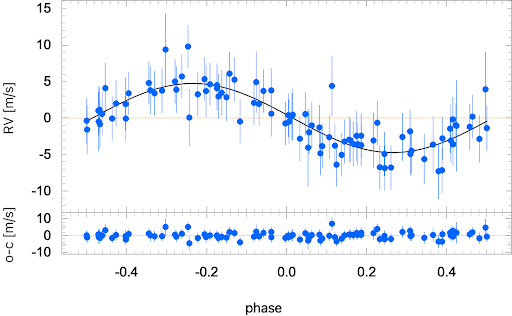
Fig.7: Example of radial velocity variation curve obtained using data from the GAPS project with HARPS-N@TNG for a young star hosting a transiting mini-Neptune , selected from the sample to be observed with the Ariel satellite (Filomeno et al. 2025, in prep).
Main projects in which the group is involved
- Strumentazione futura
- Surveys e Large Programs
- GAPS
- 4MOST/4SYS
- GHOsT
- PENELLOPE
- ODYSSEUS
- SHARPSTAR (SHARK survey)
- JWST-NIRSpec GTO: Star Formation in the Local Group
- JWST-MIRI GTO: JWST Observations of Young protoStars (JOYS)
- KMOS public survey: The VVV eXtended Spectroscopic Survey
- Networks and funding programs
- Network JEDI (JEts and Disks@INAF)
- YODA (INAF LARGE GRANT, P.I. B. Nisini)
- SKYWALKER (INAF LARGE GRANT, P.I. J. Alcalà)
- PATH (PRIN MUR, PI A. Caratti o Garatti)
- GO-SHARK! (INAF GO Grant, PI S. Antoniucci)
- TRAME e TRACE (INAF & MUR-PNRR grants, PI K. Biazzo)
- MUSHROOMS (INAF Minigrant, PI S. Antoniucci)
- POPS (PRIN MUR, PI S. Facchini)
- GLORIOUS : Gaia science aLerts tO find eRuptIve yOUng stellar objectS (PI T.Giannini)
- JIMMY: JWST-IFU Measurements of Mass loss in Young stars (PI M. G. Navarro Ovando)
- SPADE: Space Observations of Proto-planetary Accretion Disc Evolution (MUR-CNR-INAF grant, PI B. Nisini)
- EXOPATHS: EXOplanet Formation, Evolution and Habitability PATHwayS (INAF Grant, co-PI K. Biazzo)
Personnel
Staff:
Simone Antoniucci
Roberta Carini
Post-doc:
Daniele Fasano
Simone Filomeno
Maria Gabriela Navarro
PhD:
Maciej Bajor
Publications:
The complete list of publications can be found at the following links: